

Conservation Tales: The Race to Find and Protect Patagonia’s Native Fishes
Story by Katie Adase
Photos by: Katie Adase, Benja Escobar, Anna Astorga, Iñigo Irarrazaval and Jonny Burton

“One… two… three… four… five…” I need to stay calm, I can feel my chest getting tight as I force one agonizing paddle stroke after another. “Ten… eleven… twelve… thirteen…” How long has it been since the motor-boat dropped us off in the fjords, maybe twenty, no thirty minutes? “Twenty-one, twenty-two, twenty-three.” My lungs are burning, but I know if I stop paddling, the wind and the tide will pull me even further towards the sea, away from the rest of the team. I push forward, but I can tell that I am making no progress as the other boats get smaller and smaller in the distance. My eyes well with tears that peel off my eyelashes into the wind, no different than the raindrops stinging my cheeks. I know few can hear me when I try to call for help. The best I can do is try to maintain my position, and wait for someone to notice I am not there.
Eventually, my partner, Benja, turns around and sees my situation. He paddles back out into the bay, attaches a tow line, and we power our way toward the estuary. An hour later, 7am, everyone stands knee deep in Sphagnum, huddled around the map. “The water level is much higher than the last time we were here,” says Iñigo, a post-doc glaciologist with Centro de Investigaciones en Ecosistemas de la Patagonia. “All of the side channels were dry in November, but now it seems we will have to bushwack to the basecamp at the lake of Glacier Gualas.” In the glacial rivers of the Northern Patagonia Icefield, flow conditions fluctuate wildly and can be unpredictable, making each expedition a logistical nightmare.
Today, at the mouth of the Rio Gualas on the western side of the icefield, Benja and Jonny hoist my pack onto my back, loaded with two packrafts, my clothes, me and Benja’s sleeping bags, a tent, and our food provisions for the week; approximately 60 lbs or half of my body weight. I am fortunate that Benja has agreed to carry the heavier sampling equipment, including our electroshocking backpack, six sets of 24-volt batteries, and his personal gear. I couldn’t even lift his pack, but we estimated it weighed between 80 and 100 pounds total. For the next three days, I can feel the arches of my feet stretch with each step as we fight our way through thickets of chaura (Gaultheria mucronata) that cut our hands like tiny razors. And with each scrape across my drysuit, I know that the electrical current from the equipment that Benja is hauling will find its way through those tiny holes. When you’re wading in waist-deep glacial water, you brace yourself for the shock, which is better than your knees buckling and falling in.
Adventurers know the nature of type-II fun well, but even the most enthusiastic explorer is probably thinking, “What kind of sadistic cult are these folks members of?” To put it simply, we are conservation researchers.

Benja, Anna, and Iñigo use their packrafts to haul gear up a side channel of the Gualas River.

The crew eating dinner at basecamp. Spirits are high after making it to the glacial lake.
The first time I visited Patagonia, I was 19 years old– a freshman in college on a winter break trip. I remember standing at the summit of Reserva Tamango, in awe of the seemingly pristine wilderness, thinking, “How can I do this for the rest of my life?” Since that time, I have had the privilege of studying, working, and researching this region through various conservation projects. But each time, I became more aware that this landscape is not in fact the untouched wilderness that many believe it to be. Instead, I see an ecosystem in crisis from human impacts. Some of these threats are well-known, such as the prospect of hydroelectric dams and mining operations. Not to undercut their severity, these threats are often met with strong opposition from locals as well as the international community passionate about protecting this grand region. Meanwhile, there is a plague that is already wreaking havoc on an incredibly unique and fragile region: invasive species. The synergy of both terrestrial and aquatic invasive species has already begun to alter the Patagonian landscape in massive ways: Ponderosa pine (Pinus ponderosa) plantations increasing wildfire risks, packs of feral dogs hunting the endangered Huemul deer (Hippocamelus bisulcus), and the focus of my most recent research: invasive salmonids threatening native fish populations.
In the early 1900s, various species of trout (Oncorhynchus mykiss, Salmo trutta, and Salvelinus fontinalis) were intentionally introduced to Patagonia’s lakes and rivers by the Chilean and Argentinian governments, with the support of Europeans and U.S. officials. More recently, salmon (Oncorhynchus spp.) escaping from coastal farms in Chile have further reinforced the invasions, though all of these species enjoy a high level of protection from the government due to their profitability in the tourism and commercial fishery sectors. It is well-known globally that while the Northern hemisphere is in conservation triage trying to save wild salmon and trout populations, Patagonia is home to one of the world’s top sport fisheries. These species are so well-liked in the region that many conversations with local folks go like this:
Them: What are you fishing for?
Me: We are searching for native fish.
Them: Oh! So brown trout?
Contrary to popular belief, there are no native salmonids in Patagonia, or anywhere in the southern hemisphere. However, the native freshwater fish community of the region is highly unique with an entire endemic genus (Percichthys) and is home to many species from the family Galaxiidae, which share populations in New Zealand and South Africa, thanks to their ancestry dating back to the mega continent Gondwana. These are the native fishes we are searching for in the glacial rivers, so remote that we are some of the first ones (crazy enough) to go out and look for them.

Benja preparing to sample floodplain habitat of a glacial river using an electrofishing backpack.

Katie measures and identifies fish caught in a backflow channel as Benja takes notes.
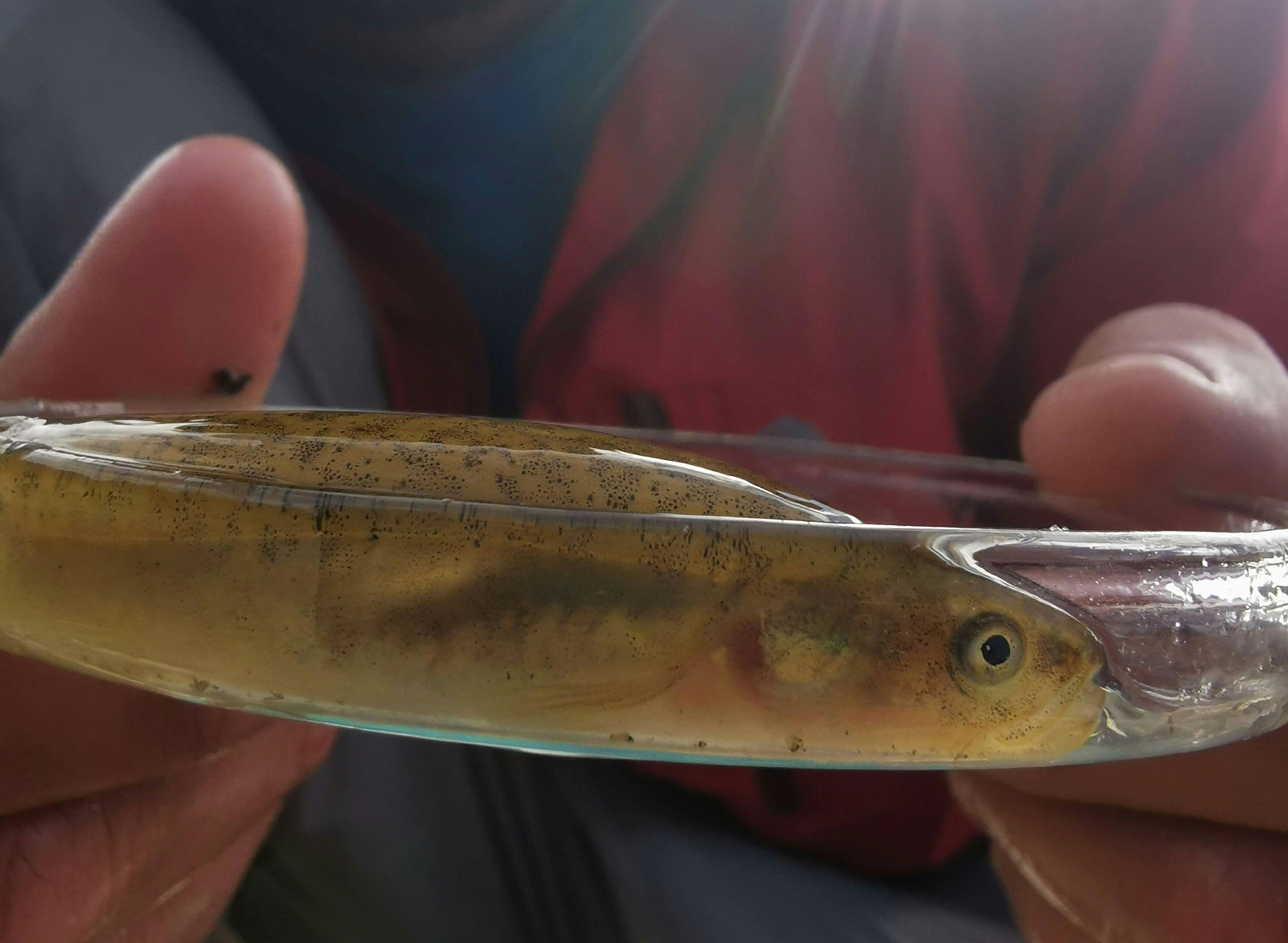
Benja holds a juvenile Puye Grande (Galaxias platei) for a picture before releasing it back into the river.
The pulse of a glacial river is strong; the incredible range of high and low flows create a complex mosaic of habitats, connecting and disconnecting in space and time. In the Gualas River valley, we only have a week to survey a variety of habitats. We wake up early, and use every moment of sunlight we have to conduct our samples. While Benja, Anna, and I explore the depths of the glacial melt, Iñigo and Jonny ascend the future river to pursue their research questions on the ice. We don’t know when the next time we will have a chance to search this watershed will be, but we do know that time is running out to find the answers to our questions.
After a week in one of the most remote locations my research career has taken me yet, we have gathered as much information as we can for the time being. We break down our basecamp on the north side of the glacial lake, and stuff our personal gear deep into the tubes of our packrafts. Tonight, we will be sleeping in our beds back in Coyhaique, but not before we make a few more stops down river- until the batteries of our backpack electroshocker run dry, we still have a chance to go fishing. We take one last look at the Gualas glacier before letting the current pull us to the outlet of the lake. Chunks of ice flank our boats, joining our seaward flotilla. A thick fog hangs low throughout the valley, concealing the vegetation covered cliff walls. It’s as if we are paddling down a river in the sky.

Jonny stands above an ice tunnel on the Gualas Glacier.

Anna paddles across the lake just below the Gualas Glacier.

Benja, Katie, Iñigo, and Jonny make final preparations before exiting the glacial lake into the Gualas River.
For seven months, we explore major rivers of the Northern Patagonia Icefield, including the Rio Exploradores, Rio Circo, Rio Gualas, Rio Nef, Rio Colonia, and Rio Ventiquero. Tirelessly, we bushwack, paddle, and trudge through the landscape hoping to find a refugia for these forgotten species. What we find are rivers dominated by salmonids, finding only 3 out of 17 known native species to the region in only a fraction of the sampled habitats. The salmonids, namely Brown Trout, Rainbow Trout, and Chinook Salmon, are aggressive predators to the native fishes in food webs that naturally have no similar large piscivores. The native fishes are left to compete for food, space, and refuge in rivers where catch-and-release of the invasive salmonids is mandatory.
In discussions with the international community of salmon researchers, I have been told, “What a great problem to have! We wish we could see populations like that in the Pacific Northwest! Why would you want to change that?” I empathize. It can be difficult to understand, as salmon are such an important ecological, cultural, and economic species in the Northern Hemisphere. And the truth is that salmonids in Patagonia are here to stay. But, as someone who believes in the intrinsic value of life, and the sheer wonder and beauty of biodiversity, I cannot concede that the story of Patagonia’s native fishes should end here. We will continue to advocate for the existence of these species through exploration, education, and management practices that balance the needs of the sport and commercial fishing industries with conservation. At this time, I cannot say if there will be a happy ending for this story, but I can say it is far from over.
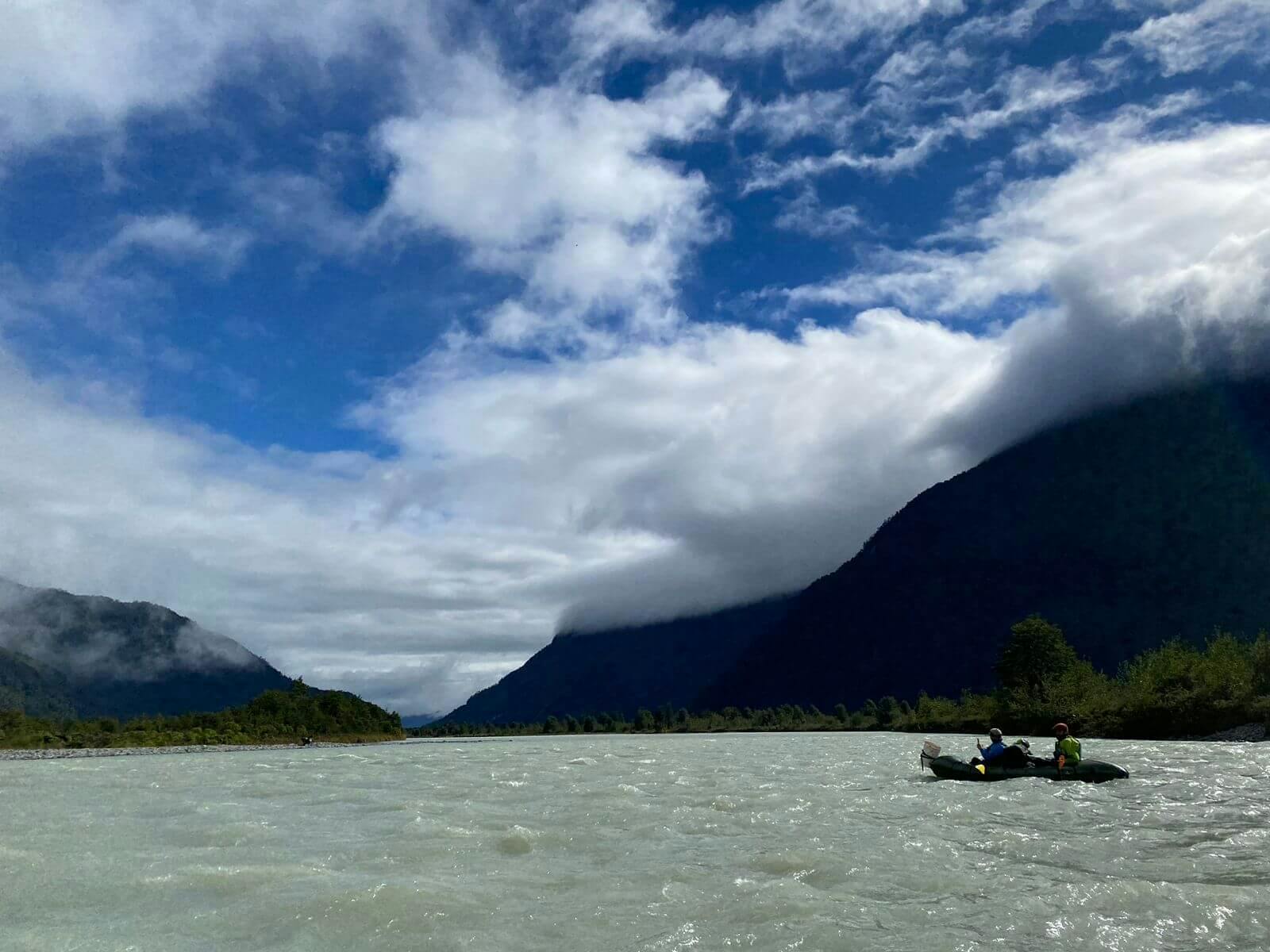
Katie and Benja paddle down the Gualas River towards the fjords.
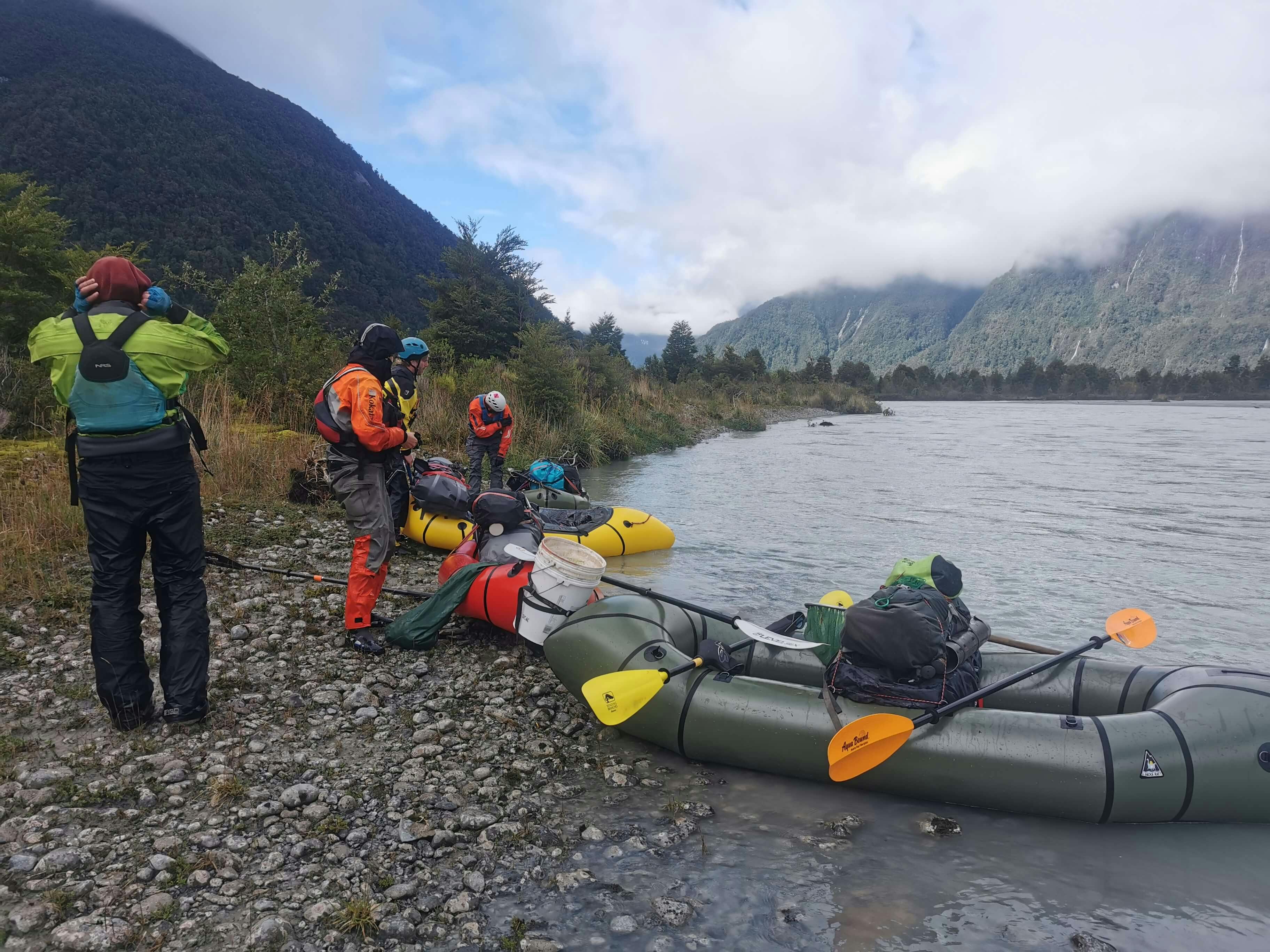
The crew takes a break on the bank of the Gualas River after a section of rapids.
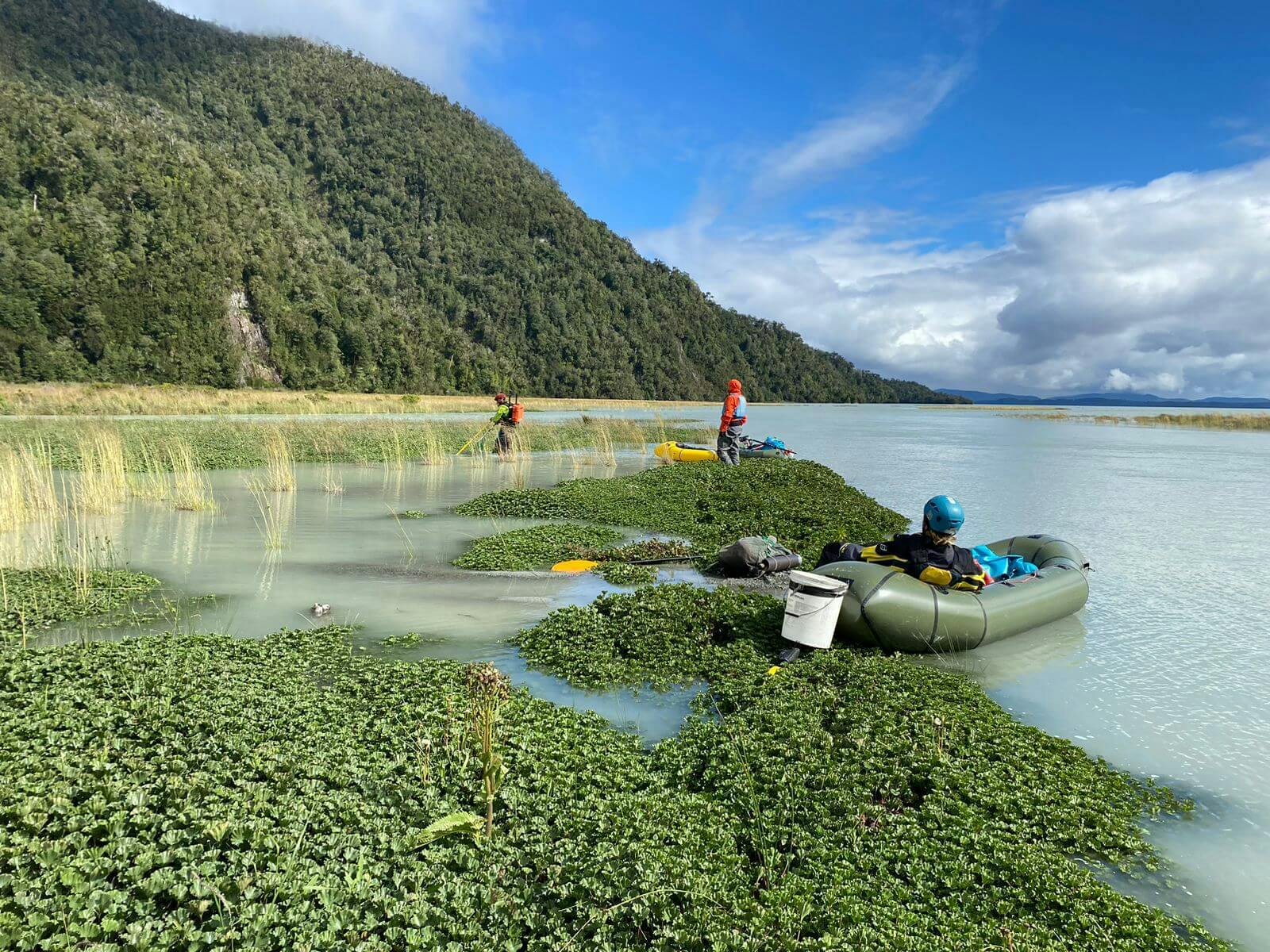
Benja electrochocks flooded vegetation in the estuary, while Iñigo and Jonny enjoy a moment of sunshine.
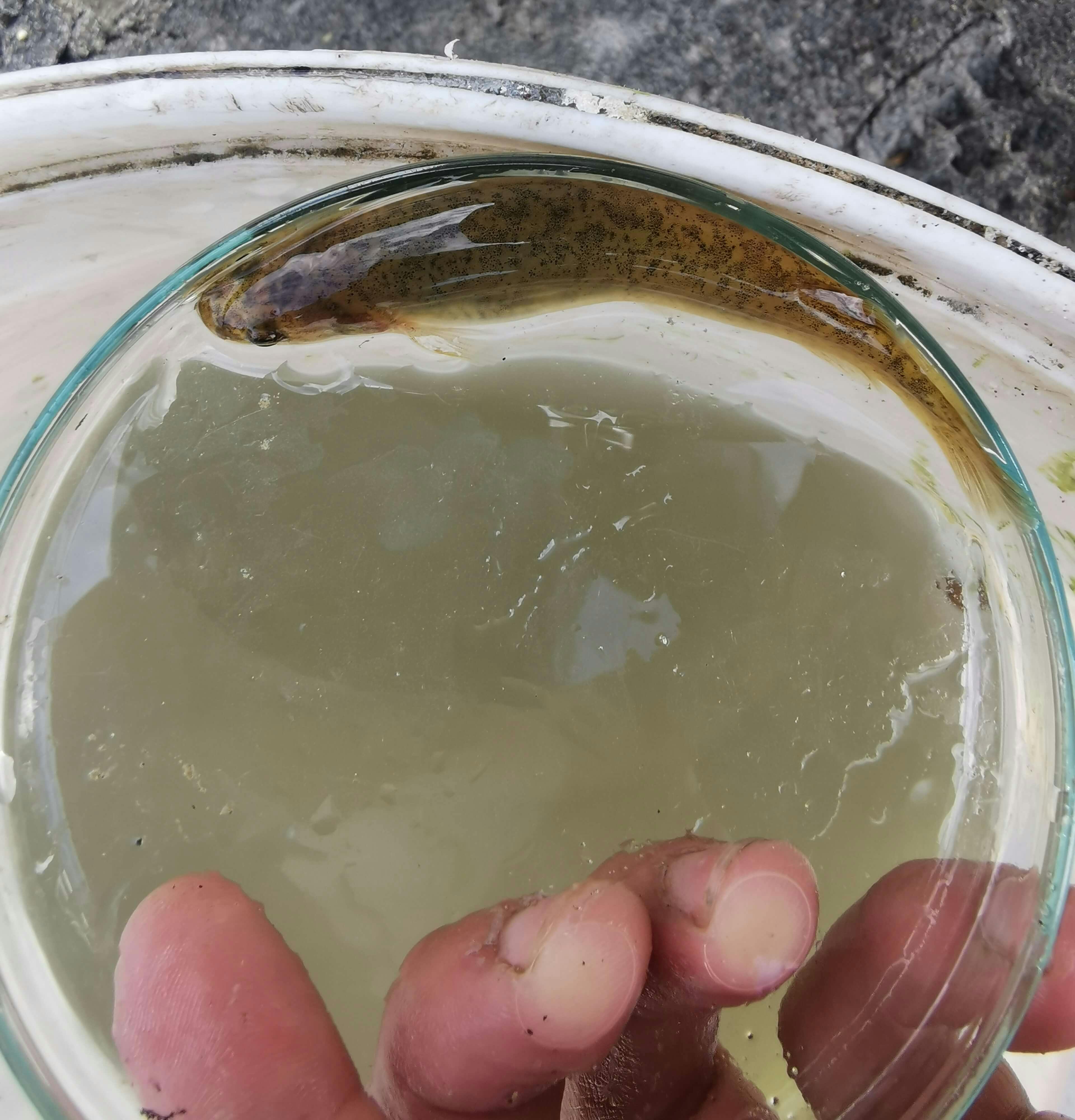
A juvenile Puye Grande (Galaxias platei) from the Exploradores River.
Katie Adase is an early career ecology researcher with interests in the impacts of anthropogenic stressors on aquatic ecosystems. Funding for the research presented in the story was provided by Fulbright Chile and supported by the Centro de Investigaciones en Ecosistemas de la Patagonia. Currently, she is an Associate Fish & Wildlife Scientist with Real Time Research in Oregon, specializing in projects on predator-prey interactions, survival-mortality modeling, climate and landcover change effects on fish survival.
Follow her on Instagram @katie_adase and ResearchGate https://www.researchgate.net/profile/Katie-Adase for updates on this and other conservation research projects.
