

Skills & Knowledge for Coastal Packrafting Safety
By Cameron Fenton
Photos: Brett Davis and Regina Kruglyak
I grew up in a canoe, but for me, sea kayaking truly opened my eyes to the world of paddlesports. As a kid, piloting my first solo sea kayak on a trip in British Columbia’s Telegraph Cove, I discovered a freedom and joy that would eventually lead me to become a sea kayak guide, get into hard-shell whitewater kayaking, and find the wonderful world of packrafting. Seeing a pod of orcas off the bow of my kayak also didn’t hurt.
So, when I saw the first images of the new Alpacka flatwater boats, specifically the Chinook and Aleutian, my mind started spinning with visions of wild coastal adventures. I started thinking about linking up coastal hiking routes on the west coast of Vancouver Island. I dreamed of hiking over high divides into remote fjords filled with sea birds, seals, whales and salmon. I smiled at the thought of a packraft that was actually fun and efficient on flatwater.

Photo Credit: Regina Kruglyak Paddling the Chinook on a coastal exploratory trip near Whittier, Alaska.
But the part of my brain that teaches packrafting courses also started thinking about safety. I remembered some poorly planned sea kayaking trips and close calls I had when I was first exploring saltwater. And, I made a list of all the skills I would need to brush up on before taking one of these boats out on a big adventure. Skills that every paddler should know before tackling coastal waters.
1. Reading a Nautical Chart
We sometimes use the word flatwater to describe any paddling that isn’t happening on a river. It’s a helpful distinction, but it’s also incorrect when it comes to the ocean. Underneath what can sometimes look like a placid surface, oceans are a maelstrom of tidal flow. Often, this flow is deep enough and slow enough that it doesn’t impact us on the surface, especially in the near-shore coastal waters that the Aleutian is designed for. But, it can also manifest as raging currents, especially in inlets, passages and other areas where vast volumes of saltwater move through narrow spaces between the land.
The best way to understand and predict where these kinds of hazards will exist is by learning to read a nautical chart. Sort of the oceanic equivalent of a topographical map, charts detail everything from ocean depth to types of beaches, land use designations along the shore and, perhaps most importantly, the location and direction of strong currents. There are loads of online programs and books about reading charts. And many sea kayaking clubs offer free or low-cost courses.
2. Understanding a Tide Table
The second piece of the puzzle for planning ocean trips is understanding tide tables (or tidal datum, a tide chart, etc). Published by government agencies, these annual resources predict the timing and heights of tides. Typically linked to known buoys or locations, learning how to read a tide table can be helpful for basic things like finding good campsites and knowing when and where to launch and take out.
But, with more knowledge, you can also use tide tables to understand the ebb and flow of water. This understanding can help you predict, for example, when a current flowing between two islands will be at its strongest and when it will allow for easy and safe passage.
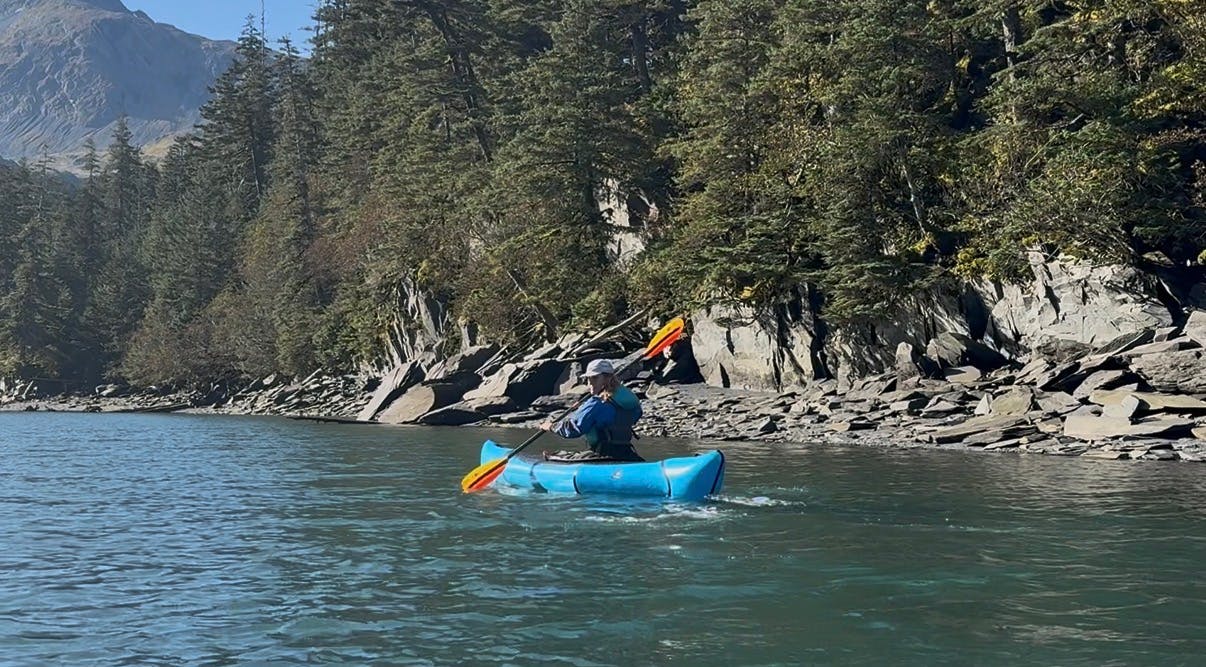
Photo Credit: Regina Kruglyak Paddling the Chinook on a coastal trip near Whittier, Alaska.
3. MarineForecasts
Weather and getting forecasts can also be different on a big coastal adventure. In addition to temperatures and precipitation, you’ll want an understanding of winds and sea state. A term used to describe the general condition of the ocean surface, sea state deals with the underlying swell as well as the predicted height and speed of waves. It’s not uncommon for coastal paddlers to look out at something thinking it’s benign, then paddle out only to find themselves in rough and dangerous seas.
There are several ways to get marine forecasts. If you have service, they’re searchable online, and many countries have a phone line where you can call to hear a recorded marine forecast. Many satellite communication devices, like the InReach, offer the option to request marine forecasts in offshore environments. Sometimes, the most reliable tool is a VHF Radio tuned to the marine weather channel for your location.
4. Speaking of Radios...
In rivers, we’re rarely dealing with paddling around motorized craft, especially the kinds of large, commercial vessels you can run into offshore. That obviously poses new risks, especially since, in most maritime settings, the general rule is “might makes right,” or put another way, the larger vessel has the right of way. But it also means that, in the event of an emergency, there may be folks nearby able and even obligated to help you.
Coastal kayakers will often carry a VHF radio for this very reason. Most ocean-going vessels are equipped with a VHF radio tuned to a shared local frequency. This allows for communication to avoid collisions and for parties in distress to call for help. Keep in mind that most places require paddlers to hold a license to use these radios, but a short course will get you that and teach you the ins and outs of radio codes, channels and communication best practices.
5. Rescues
Practice. Practice. Practice. Make sure to get out and practice self and companion rescues in these new packrafts, ideally in choppy, rougher waters. Sea kayak rescues are different from packrafting rescues and also different from whitewater kayaking rescues. Consider trying out things like a partner t-rescue or solo paddle float rescue, and figure out what works for you, so if you do end up having an out-of-boat experience in coastal waters, you’ll know what to do.

I can’t wait to get my hands on one of these new boats for some coastal exploration. But in the meantime, I’m going to spend some of this winter refreshing my knowledge and skills when it comes to coastal paddling.
Side Note: The Chinook and Aleutian are great companions on coastal paddling adventures, but please make sure to know before you go and steer clear of open water unless you are a very experienced ocean paddler.