

Luck of the Draw
An Unsupported Packrafting Trip on the Grand Canyon
Story, Photos and Film by: Jacob Kastrup Haagensen
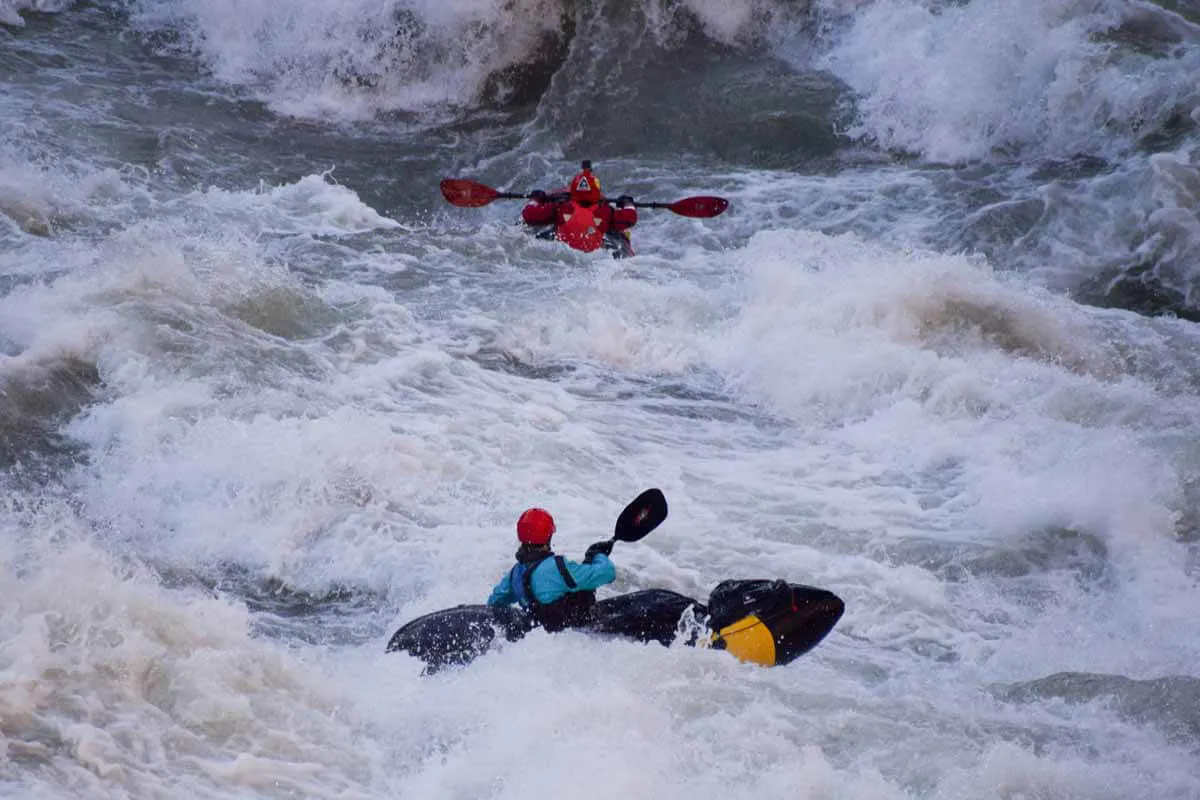
I watched the first group of packrafts head towards the mouth of Lava Falls Rapid. The entire morning had been spent in tense silence. Everyone was understandably nervous. Lava is the biggest and most feared of all the rapids in the Grand Canyon. The most famous waves of Lava Falls even had their own names, such as V Wave, Five O, and Big Kahuna. They were massive and could easily flip a large 18-foot raft, let alone our small packrafts. On Lava, there was no easy line or way around it.
An Unexpected Invitation
Just two months earlier, an email had landed in my inbox. "Hey Jacob, Ben Philips here. Would you join me for a self-supported packrafting trip down the Grand Canyon?"
Ben inviting me to paddle the Grand Canyon speaks volumes about the packrafting community. I had met Ben three years earlier at the first Swedish packraft roundup, and though we hadn’t kept in much contact since, that meeting led to an email invitation to the Grand Canyon three years later. There aren’t many packrafters, but those of us who do it feel like part of a small international family, with a good friend in every country.
Paddling the Grand Canyon is not something you just do. A permit is obtained through a lottery, with around 8,000 people competing for roughly 450 permits each year. In other words, getting the opportunity to paddle the Colorado River through the Grand Canyon is not something you turn down. So, somehow, I managed to convince my boss, my girlfriend, and our 1½-year-old son that it was okay for me to be away in the weeks leading up to Christmas.
There were 16 of us in the group set to packraft through the Grand Canyon. Four of my European packrafting friends were also invited. The rest were Americans, either Ben's colleagues or old friends.
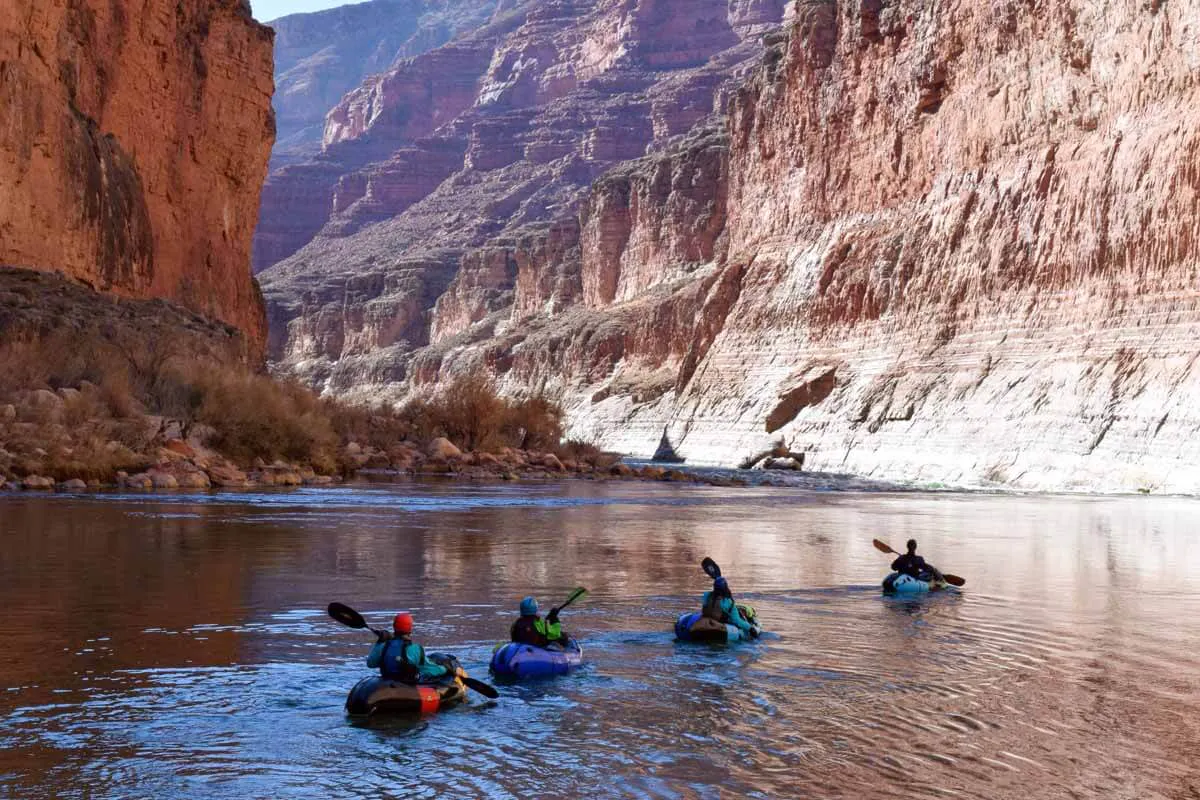
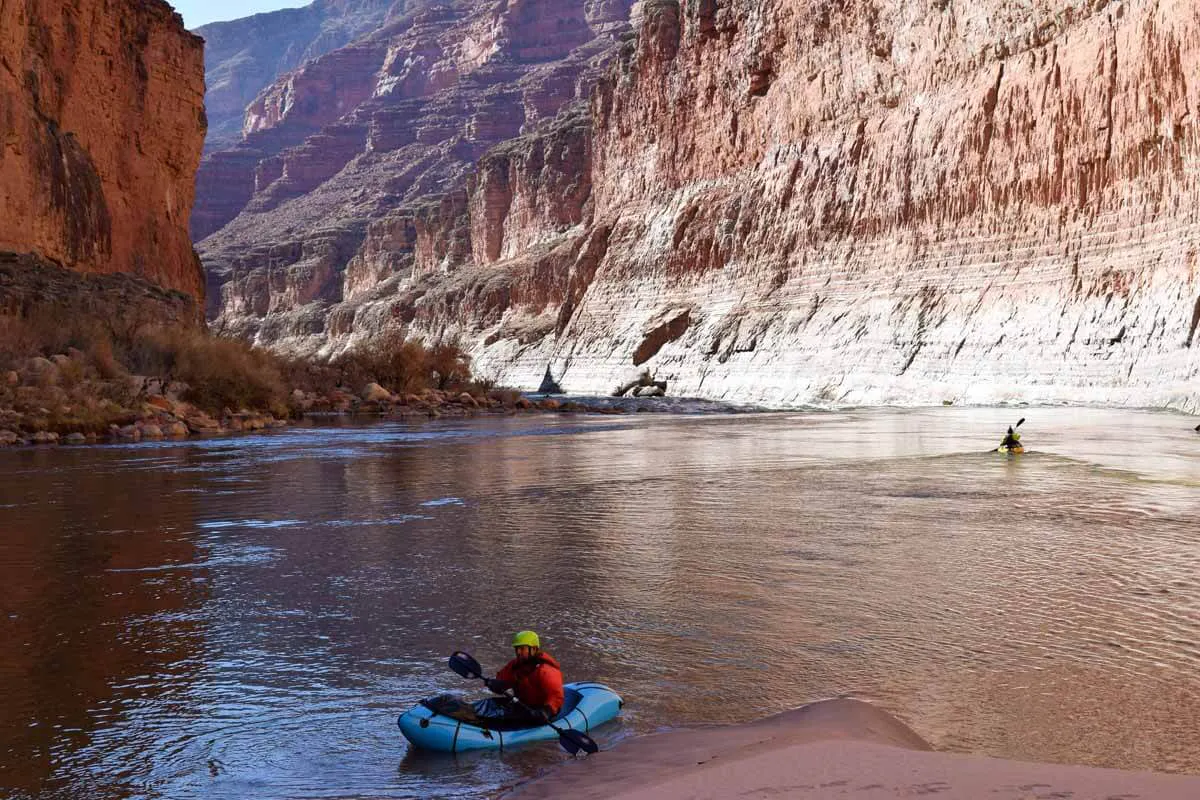
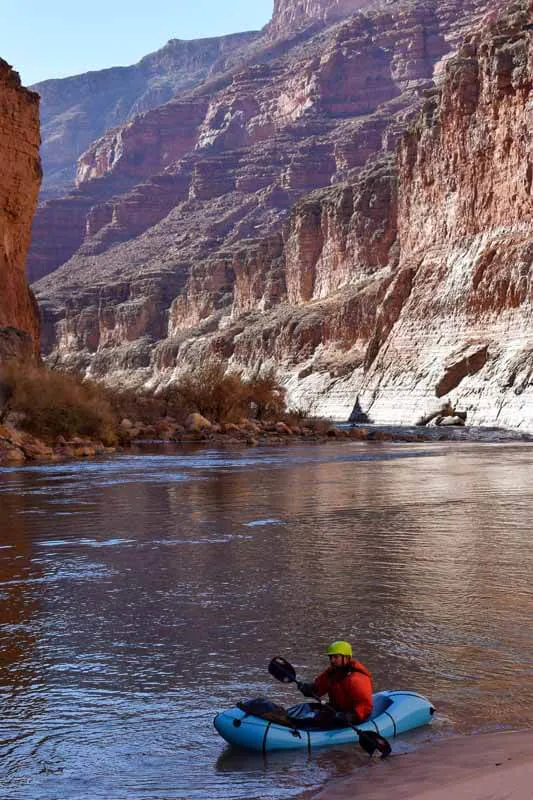
I took the opportunity to buy a new two-person packraft, the Forager, which would be great for family trips. Just 6 kg, with space for two adults, a child, and plenty of gear. I wasn’t sure if I dared paddle this new boat instead of my old one-person packraft. But when Ben found me a partner to paddle the two-person packraft with, the decision became easy. Aubrey, in his early 40s, had rafted the Grand Canyon six times before. However, it was his first time in a packraft, and you could tell by the amount of gear he brought. Two-thirds of what we could fit in the boat was his stuff, despite the fact that he didn’t even bring a tent.
I was reassured by the fact that I would share the packraft with a Grand Canyon veteran. However, the calm only lasted briefly. As soon as we were out of sight of the park ranger at the launch point at Lees Ferry, Aubrey started talking about the massive rapids awaiting us farther down the river. "Puff puff puff," he said, gesturing with his hands to show how the spray shoots up over the horizon line of the large rapids farther ahead.
Struggling with Anxiety
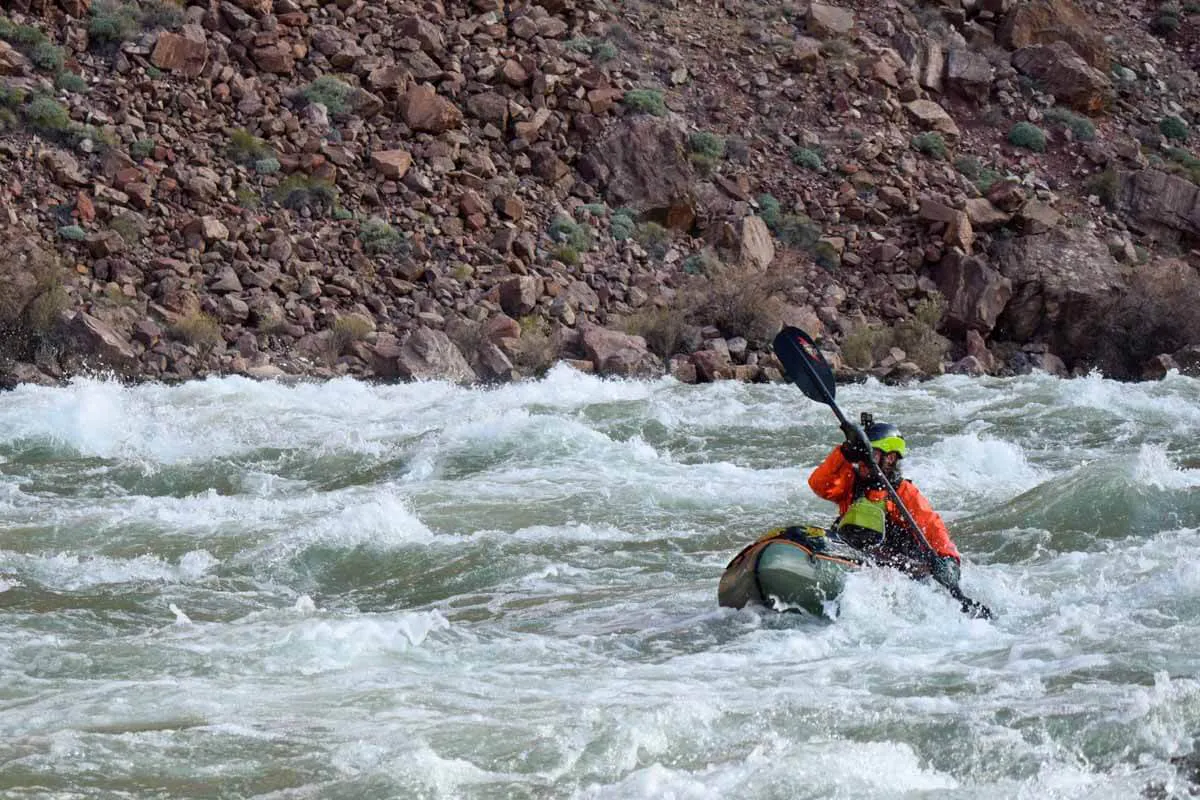
Before the Grand Canyon, I had struggled with anxiety about paddling rapids. It started with a long and unpleasant swim in Sweden’s whitewater mecca, Åre. Along with a growing awareness of the dangers of fast-moving water and the natural responsibility that comes with being a father, I had been dealing with an increasing fear of whitewater paddling. I had partly managed to ignore it during the planning of the Grand Canyon trip, but as the enormous red sandstone cliffs closed in around us and the river, it became hard to ignore.
Even the first rapids were large compared to what I was used to from Swedish rivers. However, they were only called ripples, not real rapids by Grand Canyon standards.
The Colorado River flowed swiftly, and by late afternoon, we were almost 30 km down the river. The plan was to camp below House Rock Rapid. House Rock was one of the first really big rapids. The line was simple: start in the middle and then paddle as fast as possible to the right to avoid the massive waves along the cliffside to the left. Aubrey and I were first and succeeded in the maneuver. But many others weren’t as fast, and from the shore, we watched one after another go right into the huge waves and holes. Some made it through, but many had their first of many swims on the first day at House Rock.
The Roaring 20s
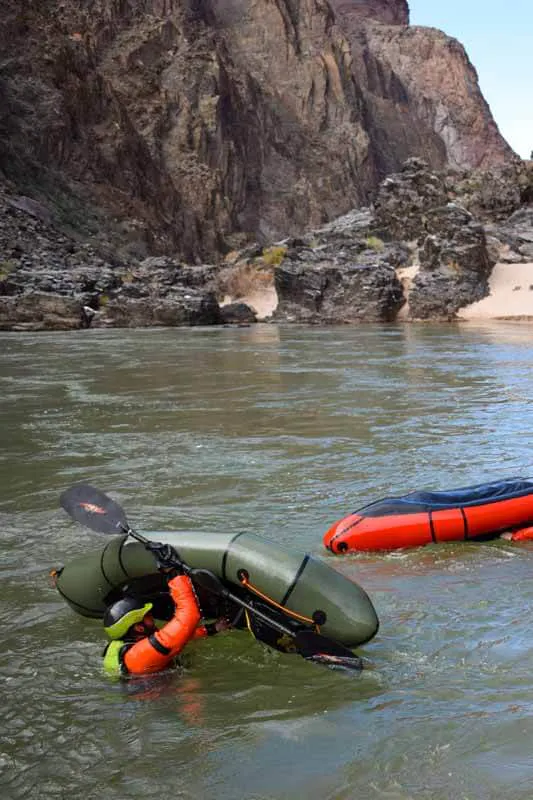
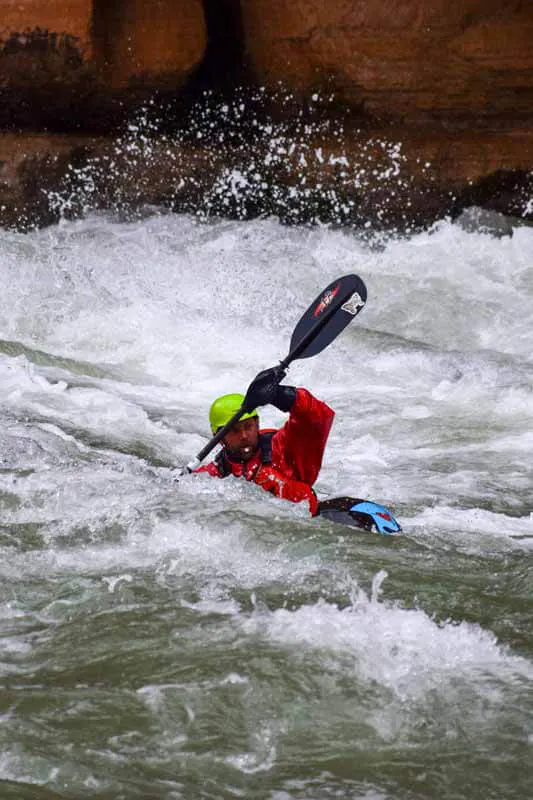
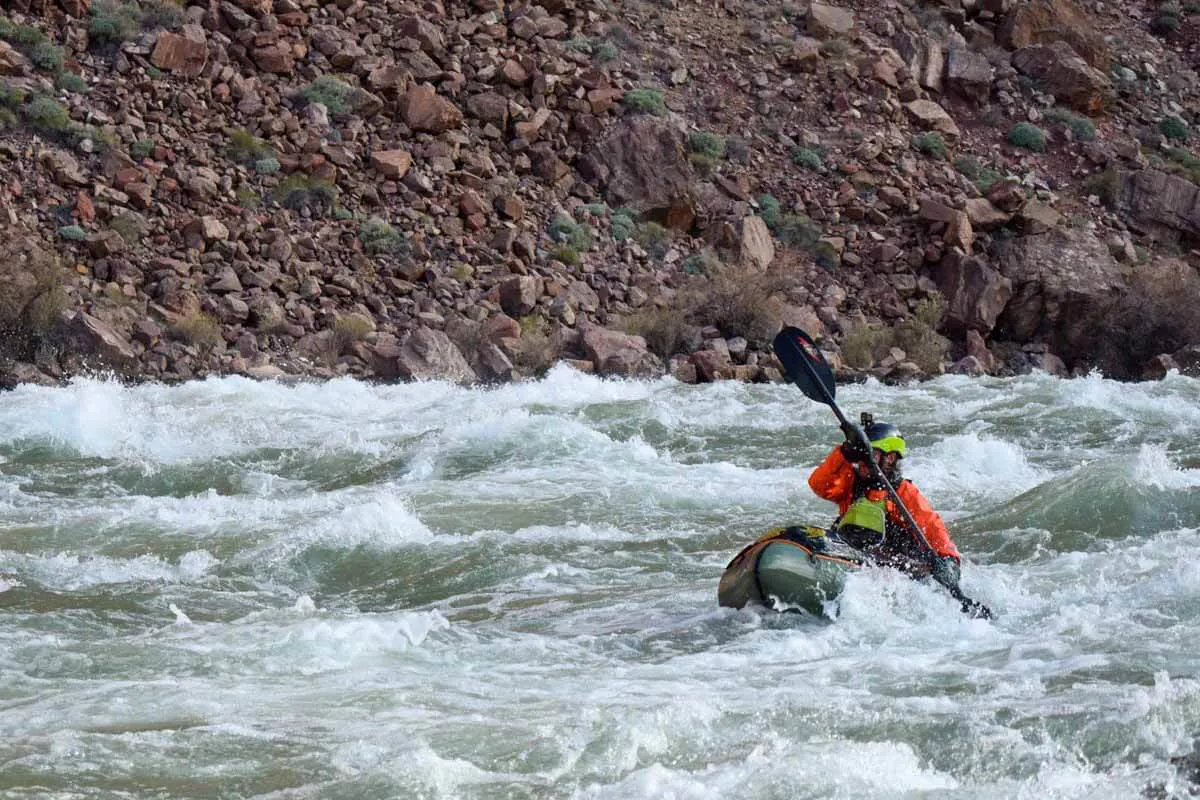
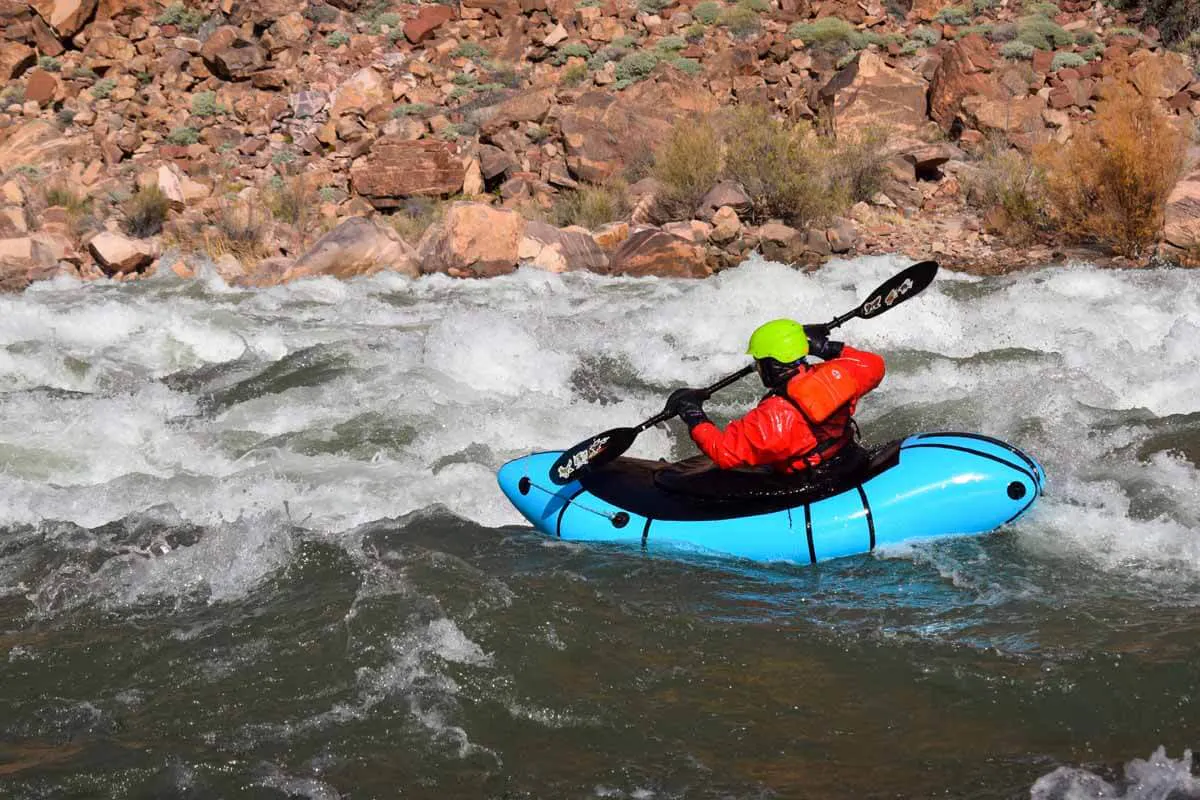
The next day brought a series of rapids known as the Roaring Twenties. The Roaring Twenties were so-called because they were all lined up like pearls on a string between miles 20 and 30, measured from Lees Ferry. In the first rapid, two waves hit Aubrey’s and my packraft perfectly. The first wave stole our momentum, and the next wave tipped the balance. Soon, we were both swimming in the cold, rushing water, holding onto the bow line. Below the rapid, we swam the packraft into an eddy and flipped the boat over so we could climb back in.
An eddy is a place, usually behind a point or rocks, where the water circulates back upstream. Where the two opposing currents meet is called the eddy line, which can be quite powerful in large rivers like the Colorado. These are gold when paddling rapids, as they offer a chance to escape the current. However, during our journey down the Grand Canyon, it also happened that we mistakenly crossed an eddy line and found ourselves lagging behind the other packrafts while we struggled to paddle back into the current.
Not long after, Caj from Finland flipped over in a rapid. Caj was dragged underwater by the bubbling eddy line and didn’t resurface until a little farther down the rapid. His packraft, on the other hand, continued downstream. Aubrey and I set off after Caj, but before we reached him, we were already in the next rapid of the Roaring Twenties. My arms were burning, and I was exhausted when we finally caught up with Caj and pulled him up between us in the packraft. Someone else had caught his packraft, and after we found a calm eddy, Caj was soon back in his own packraft again. Chasing down those who flipped in the rapids became a regular routine for Aubrey and me, as our two-person packraft could carry an extra passenger.
The Roaring Twenties were a rude awakening to the realities of the Grand Canyon. John from Texas, the expedition's doctor, flipped dangerously close to some large rocks. Everyone held their breath, hoping that John would resurface farther down the river without getting trapped between the rocks. A sigh of relief spread through the group when we saw John in the water, a safe distance from the dangerous rocks. Generally, it’s relatively safe to paddle the Colorado River because the volume is so large that contact with the bottom or rocks is rarely a risk. But here, it nearly went wrong.
Sandstorm and Zippers
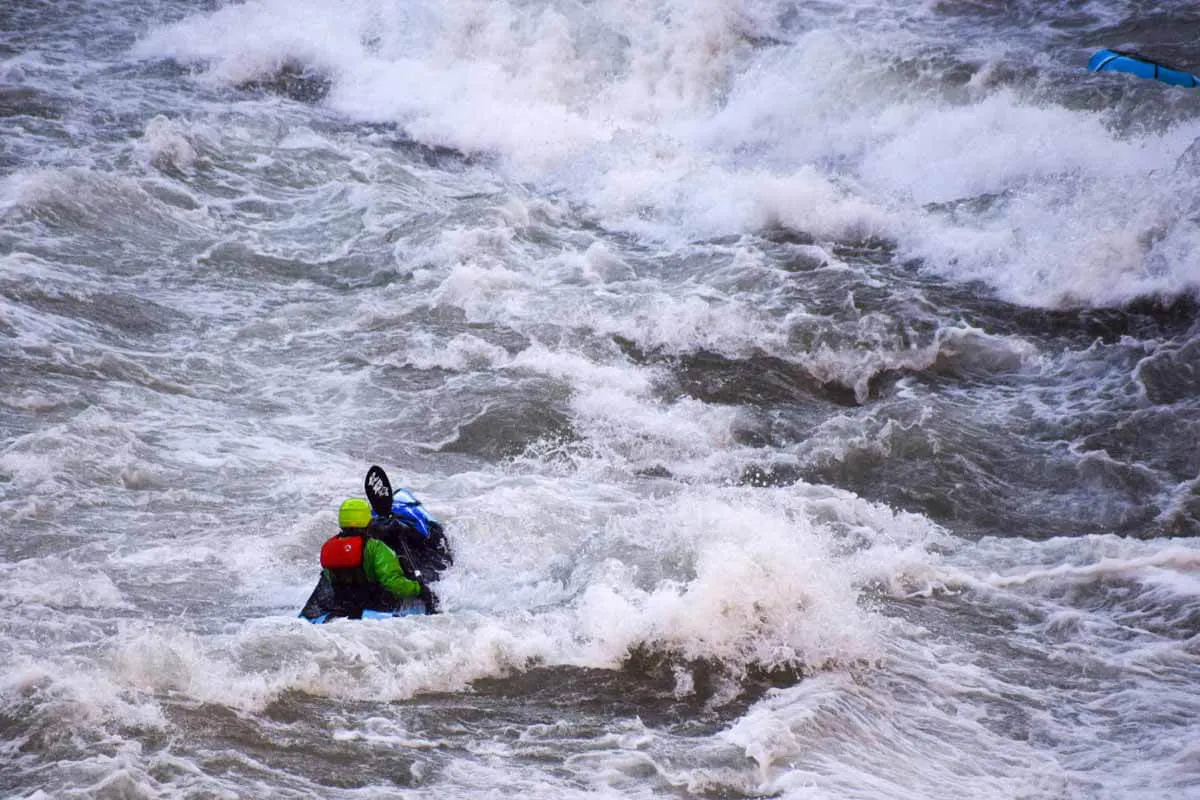
After lunch, the situation changed. With the Roaring Twenties behind us, we had hoped for a peaceful afternoon to acclimatize to life in the Grand Canyon. But after stopping at a spring to refill our drinking water, the wind began to pick up. Strong downdrafts from the Colorado Plateau above the rim blew down the canyon, and soon the wind was so strong that we barely had any forward momentum. Sand filled the air, and we crept along the cliffs for shelter. The wind-created waves were fierce, and at one point, when we had to cross the river, someone capsized their packraft.
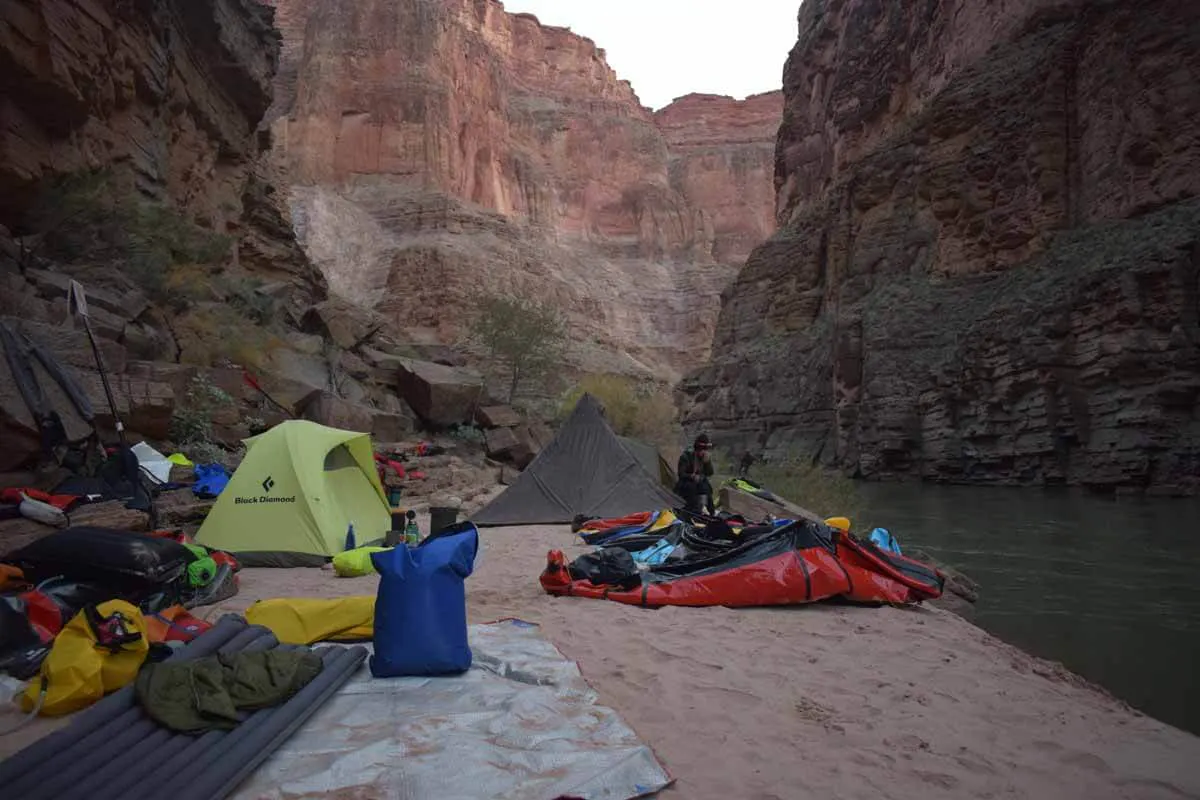
The harsh conditions made it impossible to continue, and it quickly became a race to find a protected campsite. In this upper part of the Grand Canyon, campsites were small sandy beaches along the cliff walls, where it was often a puzzle to fit all the tents. Eventually, we found a somewhat sheltered camp, where an overhang in the cliff, along with sparse vegetation, provided enough shelter. However, sand continued to blow around us as we set up camp.
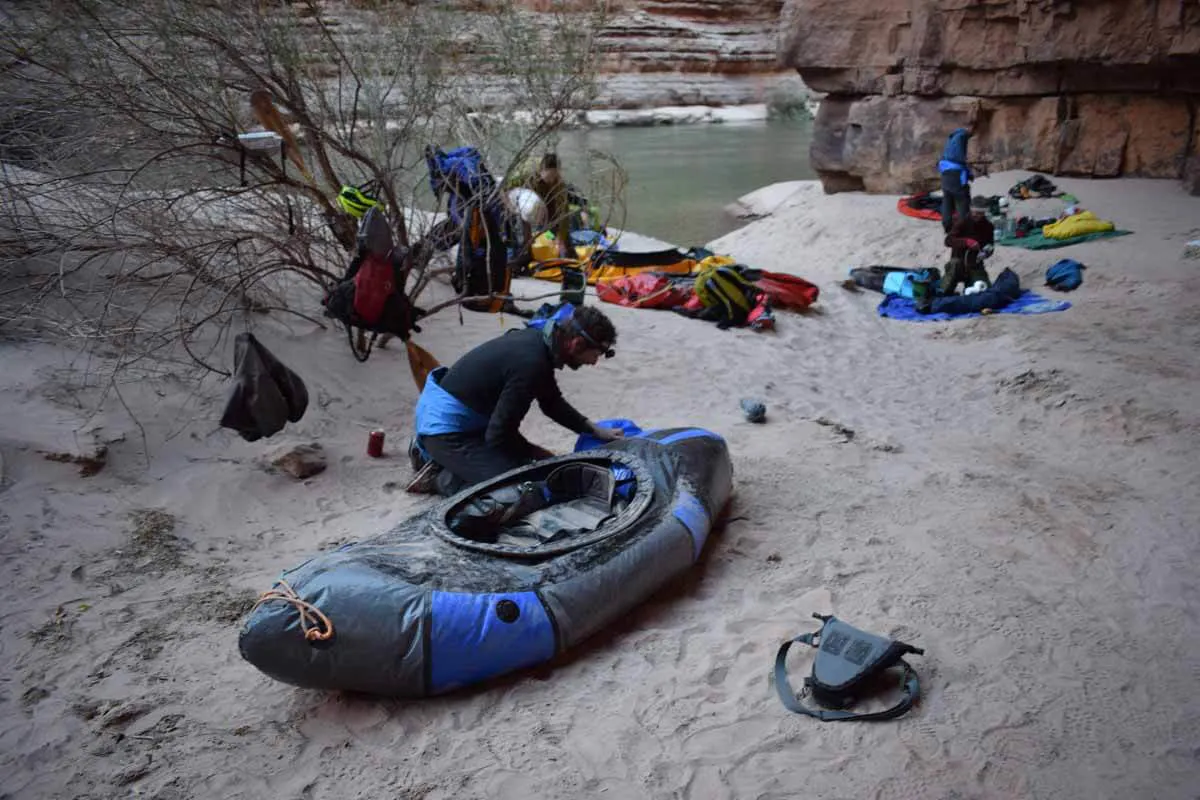
One of the improvements that makes it possible to paddle large rapids with modern packrafts is a zipper in the stern, which allows you to store gear in the tubes. This lowers the center of gravity, and you also avoid having a large backpack in front of you on the bow. The storage space is limited, though, and on a packrafting adventure through the Grand Canyon, you have to skip all the luxuries typically seen on traditional rafting trips. In other words: fewer beers and more whiskey.
Sand and waterproof zippers are, however, not the best combination, as the tiny, omnipresent grains of sand get stuck in the zipper's teeth. The day after the sandstorm, the problems were significant. With toothbrushes, cloths, and lubricant, we worked hard to clean the sand out of the zippers so we could repack our gear.
The Grand Canyon is one of the most inaccessible places I’ve ever been. Steep cliffs surrounded us, and the only exit from the valley over the next 364 km was at Phantom Ranch, where three of my fellow travelers would leave us. If we needed help beyond that, the only option would be a helicopter rescue. That is, if we were even in one of the few places where the geography allowed a landing.
This makes the Grand Canyon somewhat of a paradox, as all travel through the valley is highly regulated. Any trip down the Colorado River starts with an hour-long lecture from the park rangers, where you learn everything from the local wildlife to the national park’s many regulations. For example, campfires are only allowed in regulated fire pits with a fire blanket underneath, and when you need to pee, you have to do it in the river. With a fragile ecosystem and the many visitors each year, the rules are understandable. Still, it feels bizarre to be peeing in the river while one of your companions 10 meters downstream is collecting water for morning coffee. Anything bigger happens in so-called groovers—portable toilets named after the marks they leave on your behind.
A Journey through Geological History
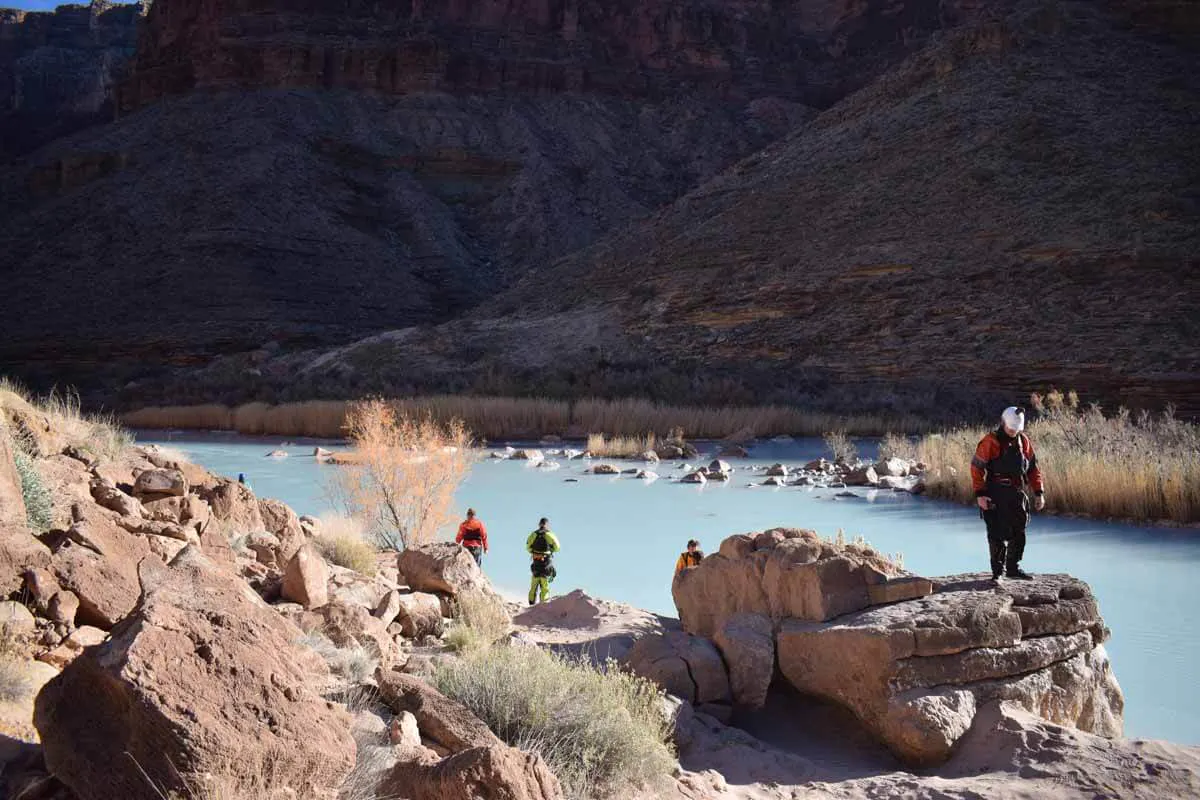
The next few days became something of a journey through the Earth's geological history. We had started out below sandstone cliffs, but gradually new layers of limestone, conglomerates, and more sandstone emerged. Eons of geological history passed us by as the cliff walls grew higher. After a few days, we found ourselves a kilometer below the Colorado Plateau, and we had time to take a half-day hike to a small peak to view the impressive valley. The landscape was straight out of a Western movie, with cacti and red rocks. Two ravens watched us from a ledge, and we could see snow near the rim of the valley.
At Phantom Ranch, we said goodbye to Steve, Jon, and Amira, who unfortunately couldn’t continue all the way to Diamond Creek. It was the last opportunity before the Colorado River entered its oldest geological layer, where the red layers of sandstone and limestone were replaced by the dark, ancient rocks of the Inner Gorge, some more than 1.8 billion years old. Between the layers, about a billion years of geological history had mysteriously disappeared in a phenomenon known as the Great Unconformity.
The Gems
It was in this crust of ancient rock that some of the Grand Canyon’s largest rapids could be found. This section is known as the Gems because many of the rapids are named after gemstones—Ruby, Sapphire, and Crystal, to name a few. The stretch was like the Roaring Twenties, but this time the rapids were the biggest and most powerful in the entire Grand Canyon. Except for Ben and his old friend Jed, no one escaped without swimming at least once that day.
Some of the big rapids, such as Hance Rapid and Crystal Rapids, had easier lines where a packraft (unlike a real raft) could sneak along the edge and avoid the massive waves and holes. Horn Creek Rapid and Granite Rapid, on the other hand, were a different story. Here, there were no easy lines between the enormous holes and standing waves. In Horn Creek, we managed to make it through, despite having to paddle from left to right across the rapid to avoid the large holes.
Granite Rapid was even trickier. We did our best but ended up a meter too far to the left and capsized in a huge hole. Swimming in Granite Rapid is best compared to being in a washing machine. The waves were fierce, and the forces enormous. I was constantly hit by waves with no time to recover before the next one hit me. I swallowed a lot of water but managed to hold onto both the packraft and the paddle. When we finally made it through and dragged the packraft to shore, I was exhausted, sat down in the sand, and coughed up water.
While Granite Rapid was my worst swim, Hermit Rapid, a few miles downstream, was the most fun. Hermit Rapid was a long, meter-high wave train. We capsized right at the beginning and ended up swimming through the entire wave train. It was like a roller coaster.
By the end of the day, I was cold from the two swims and the many waves that had washed over me in the rapids we managed. My throat was sore, and I went to bed early with a mix of Strepsils, ibuprofen, and whiskey. In one day, we had paddled four of the Grand Canyon’s five largest rapids. The only one left was Lava Falls Rapid.
Lava!
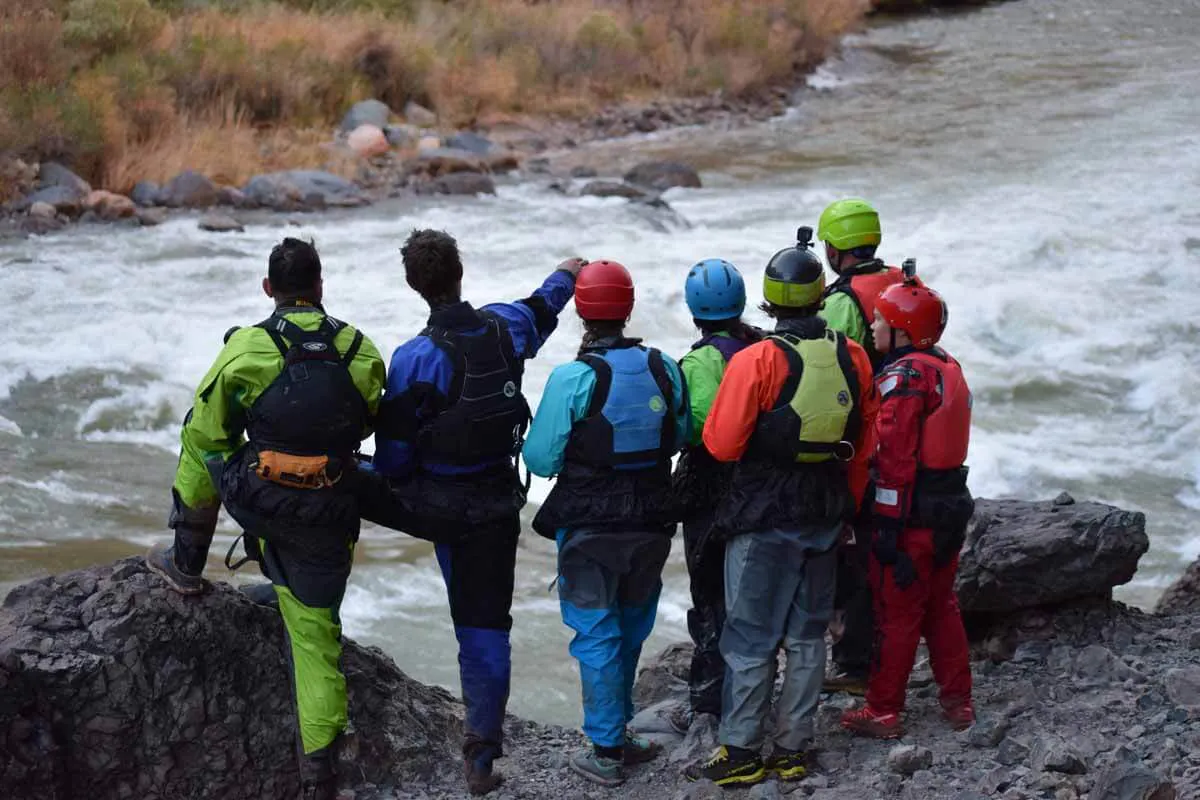
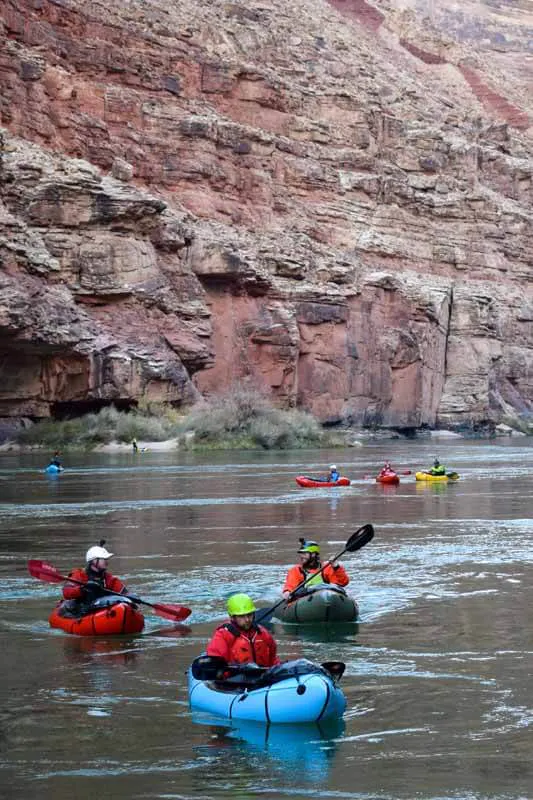
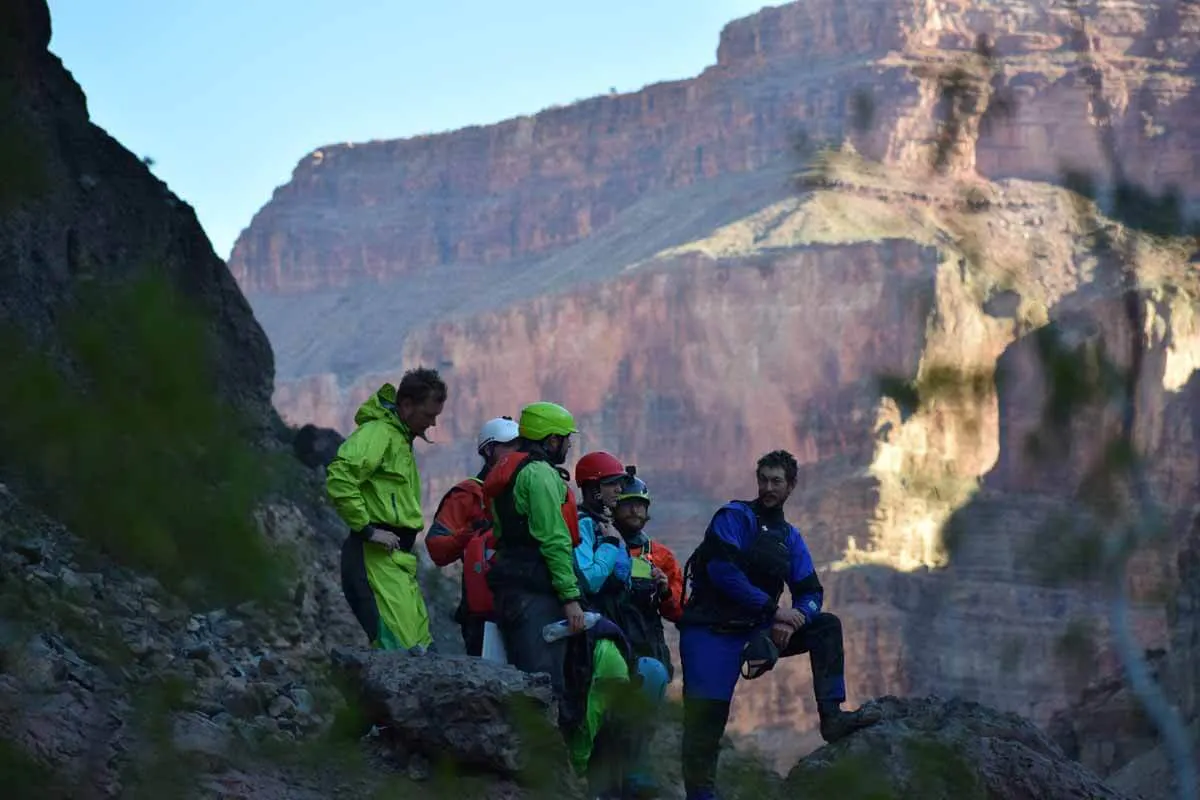
From our lookout in the cliffs on the right side of Lava Falls Rapid, we could see the massive waves tossing the small colorful packrafts from side to side. Some made it through the first wall of standing waves only to be flipped by the exploding spray farther down in Big Kahuna. Of the eight people in the first group through Lava, only two didn’t capsize. And now it was our turn.
We got into the packrafts—first Jed, then Aubrey and I, followed by Caj and finally Konstantin. Lava Falls drops 96 meters and is so steep you can’t see the rapid from above. To navigate, you follow a line of white bubbles on the right side of the river. By staying just to the right of the bubble line, you avoid the Ledge Hole that fills the middle of the rapid. Water pours over a large ledge here, creating a dangerous recirculating hole that can easily trap a swimmer under the surface for a long time with no chance of escape.
I was nervous and just hoped we’d stay in the packraft long enough for our inevitable swim to be less violent than the one I had experienced in Granite Rapid a few days earlier. To avoid the wildest waves in Lava, you have to traverse from right to left after the Ledge Hole. This is the only way to avoid the enormous standing waves of Five O and Big Kahuna. So, we paddled right through the V Wave. But despite paddling as hard as we could, the current took us mercilessly toward the massive whirlpools of waves and foam.
The waves rose like a wall in front of us. I tried to time my strokes and lean forward to gain as much momentum as possible over the enormous wall of water. We made it to the top briefly but disappeared right into the next trough in the inferno of water that is Lava Falls. And now, the three-meter-high Big Kahuna loomed ahead. I desperately tried to focus and keep paddling to maintain momentum. With Big Kahuna, you never know when the wave will decide to explode in an eruption.
We were lucky. Like a roller coaster, we went up and down the Grand Canyon’s most notorious standing wave. Somehow, we had conquered the wall of water and were down again. There were still large waves around us—waves that would have terrified me on the first day but now looked like ripples. We had made it through Lava Falls.
“We did it!” I screamed as loudly as I could. The joy was euphoric. Instead of an unpleasant swim, we had made it through the biggest rapid in the entire Grand Canyon. Between the shouts of euphoria, we looked around. Both Konstantin and Caj were swimming a little farther away. We set off after Konstantin and pulled him up between us in the packraft. We spotted Konstantin’s packraft farther downstream and went after it. But we made it all the way through the smaller Lower Lava Rapid before we caught up with it.
Tequila Beach and Shooting Stars
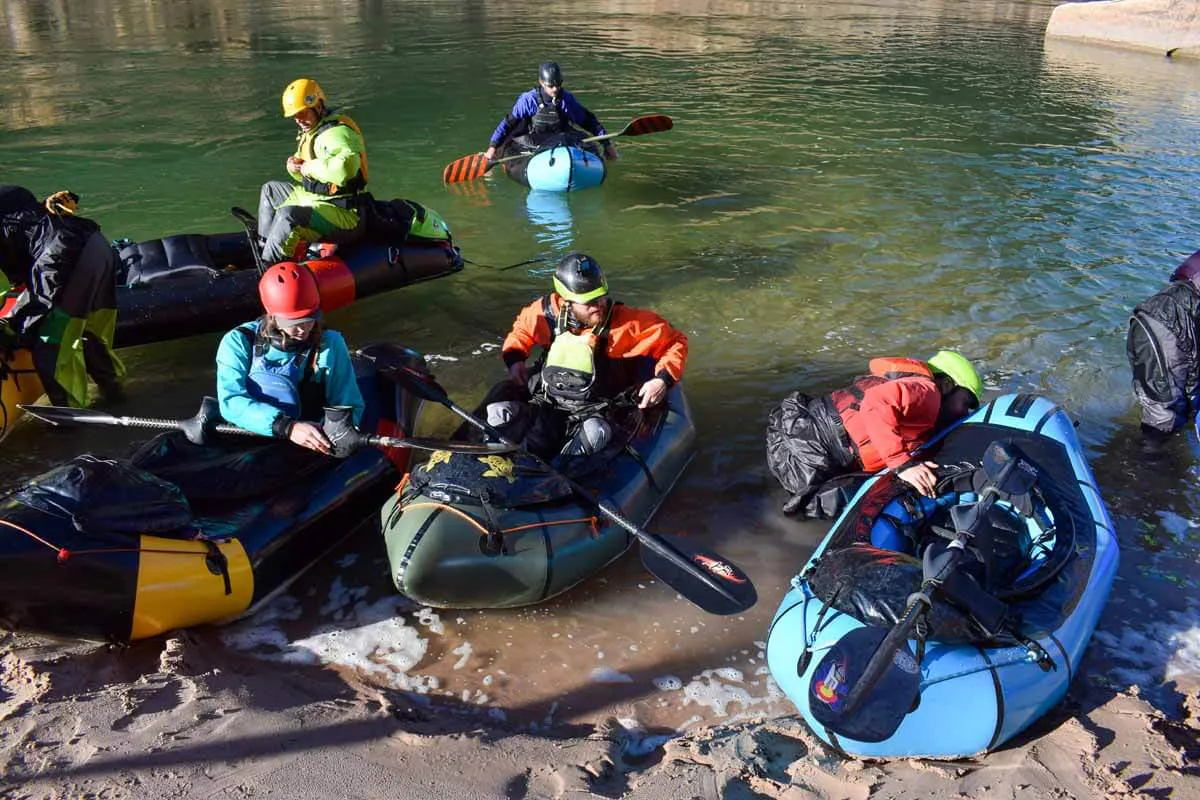
The first stop after Lava Falls Rapid was Tequila Beach, where we all gathered to celebrate having made it through Lava. The bottle of tequila was brought out, and with lime powder and a drink mix called Crystal Light, we made margaritas in water bottles. The bottles were passed around, and more drinks were mixed as we emptied them. It wasn’t even noon yet, and here we were—thirteen packrafters, tipsy and happy. But what did it matter? We had finally made it through Lava.
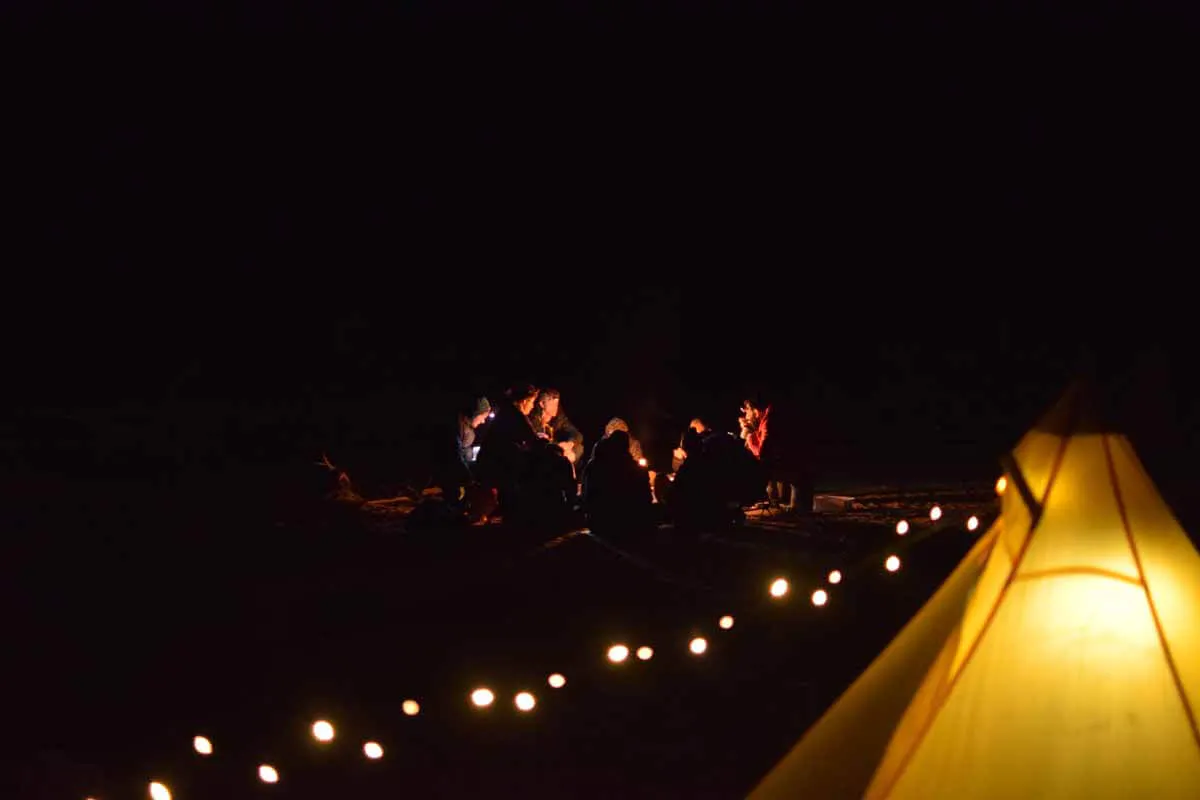
Having Lava Falls Rapid behind us also marked the beginning of the end of our journey. Sure, there were still a few medium-sized rapids to get through, and a couple of us (myself included) would get another chance to swim. But most of it was behind us. We had our last camp on the shortest day of the year. I lay under the open sky in my sleeping bag, watching shooting stars between the silhouettes of the valley’s cliffs.
I had packrafted through the Grand Canyon. Something I had never imagined would happen just three months earlier.
In Loving Memory of Ben
In August 2026, I received some very sad news. Ben Phillips, who invited me on this trip and brought our group together, died in a tragic car accident. I will always be grateful to him for giving me the opportunity to experience the Grand Canyon. Rest in peace, Ben.
In Loving Memory of Armida
Armida Huerta was also on this trip and she has also passed away.
You'll also see her name at the end of the credits and she too, is dearly missed.
Watch The Film!
Meet the team on this trip and watch the film showing more than what you see in photos. And getting a sense of the nerves
Jacob Kastrup Haagensen lives in Sweden with his family, working as a city planner by day and pursuing his passions for packrafting and documentary storytelling in his spare time.
You can watch his film and follow his adventures at: